We begin with a map.  A map from TD-Architects, which seems to have a lot of interesting content though remarkably difficult navigation.  A map that might be from 2006 or 2007 (or 2009?).  The source of the income data?  Unknown.

Anyway, the idea of the map is that 73% of the world’s income is being protected on all sides by walls or, as they are called, “heavily guarded border zones” in an effort to create the “greatest wall” ever built on this planet.  Go ahead, take a look…

(click to enlarge)

If you want get into the flaws of the map, reddit has conveniently ripped it apart on multiple occasions, including this 400+ comment thread.  The gist is that “heavily guarded” is an exaggeration, the selections are arbitrary, and there are plenty of wealthy areas outside these borders.  …  But is it still conceptually interesting?

While looking into the income data, it turned out that these countries within the so-called walled world match up with the World Bank‘s list of “High Income” members of the Organisation for Economic Co-operation and Development (OECD).  Since 1973, these countries have made 70-80% of the world’s income year after year, that is until 2006 when their percentage started to drop.  The situation really is changing, and as of 2010 the high income OCEDers were down to 63%, but the map really is a SNapshot Of Globalization, which is what TD’s SNOGs are all about.

Tomorrow we’ll use a somewhat flawed chart to take this a step further.

For more on those walls: DMZ, Australian Defense Force, Mexico-United States barrier, EU Maritime Borders, Melilla & Ceuta border fences, Schengen Area, Israeli West Bank barrier.

For more on the data: The World Bank is offering a killer 200,000+ line spreadsheet full of all kinds of data or if you’re more of a charts person, check it out via Google’s Public Data Explorer.

[Map via Information is Beautiful]

World Debt Scoreboard

 Posted by on February 14, 2012
Feb 142012
 

Not good with your money?  You’re not alone…

(click for full size active clock (loads slow))

Check out the full U.S. Debt Clock for an economic eyeful

What’s Your Line, Brother?

 Posted by on February 13, 2012
Feb 132012
 

From Daniel ClowesWilson:

Some Ivy League students are starting to agree with the sentiment after watching so many of their peers head off to work in consulting and finance after graduation.  From All Things Considered’s Stopping the ‘Brain Drain’ of the U.S. Economy

Student protesters recently got into a Goldman Sachs recruitment session at Princeton University to tell student attendees they were listening to a “carefully crafted recruitment pitch” and that they could “do better for society.” Similar protests have been held at Harvard University, and at Stanford University, where Teryn Norris was a student. …

“The problem is that when you’ve got 20 to 30 percent of some of the top talent in this country going into a sector that is not necessarily contributing to economic and social productivity,” he says. “That’s a problem for the country at large and it’s something that we should all be concerned about.”

Economist Paul Kedrosky agrees, except that we’re about two decades late in getting concerned.  He believes the current financial morass is the work of a long line of bright minds who decided to spin their wheels in the name of money, as opposed to areas like science, engineering and mathematics, a.k.a. the subjects many of them actually studied in school…

[Wilson is available from Drawn & Quarterly; NPR story via Hacker News]


From Mother Jones:

The nation’s 10 largest financial institutions hold 54 percent of our total financial assets; in 1990, they held 20 percent. In the meantime, the number of banks has dropped from more than 12,500 to about 8,000. Some major mergers and acquisitions over the past 20 years:

big-bank-theory-chart-small(click to enlarge)

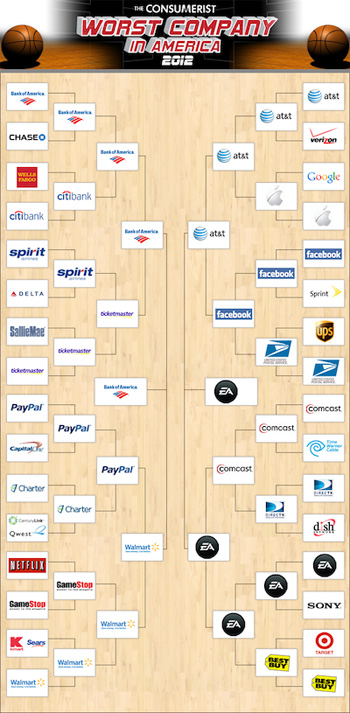
It might look like a sports bracket, but competition requires competitors and 33 of these players aren’t coming back next season.  The object is to best other companies, not eat them.

For a similar look at the investment banking game, see the New York Times’ Wall Street Vanishing Act chart.

[Chart from Mother Jones via /r/Economy]

It’s Never Enough

 Posted by on January 25, 2012
Jan 252012
 

When one’s income increases, the tendency would be to expect standard of living to go with it.  In the following example, however, once you’re making $10,000 a year, you might feel just as poor making $40,000.

The issue is the balance of subsides and taxes on the lower income brackets.  The stagnation comes from the loss of social benefits as income rises.  Food stamps turn into grocery bills.  Free health insurance turns into… costly health insurance.

One way of looking at the situation, and the one taken by the Mises Institute, which made the chart above, is to say that by helping the poor, we are taking away the motivation to work.  And sure, when you find out low-wage work might leave you with less money than being unemployed, where is the motivation?  But, what’s the problem here: the helping of the poor or millions of full-time jobs that don’t pay enough to make ends meet?  Ape Con Myth’s take on the chart is that the base cost of life for hypothetical families of three in Virginia is about $40k.

But that’s Virginia.  What about the country as a whole?  Below we have similar charts based on singles and couples at ages 30, 45 and 60 from a Boston University/National Bureau of Economic Research report.  Don’t worry about the fine print.  Just notice how different they all are…

(click to enlarge)

As the researchers were quick to point out, “the patterns by age and income of marginal net tax rates on earnings, marginal net tax rates on saving, and tax-arbitrage opportunities can be summarized with one word – bizarre.”

What do they think of our chances of understanding the elements at work?  “Thanks to the incredible complexity of the U.S. fiscal system, it’s impossible for anyone to understand her incentive to work, save, or contribute to retirement accounts absent highly advanced computer technology and software.”

Try doing that on a computer at a library.

[Mises chart and NBER report via Greg Mankiw via Kottke]

Dec 212011
 

Perhaps this century we can help corporations get on board with this simple notion.

[via /r/occupywallstreet]

Dec 152011
 

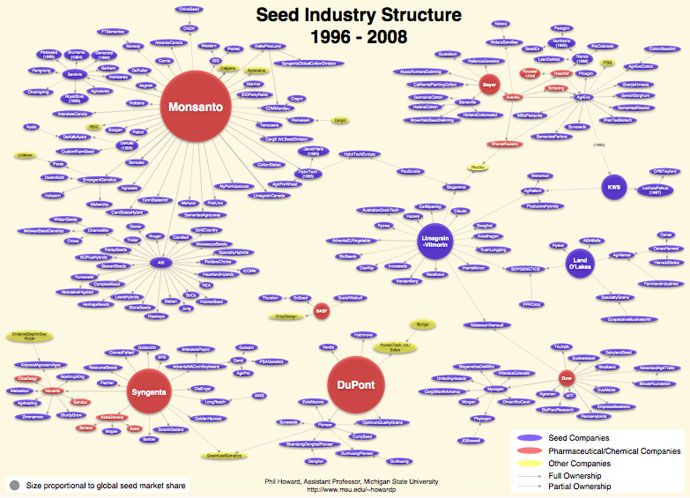
The formula for soft drinks is pretty simple, which might explain why there are so many of them on the market.  Water + a Sweetener + a Flavoring Agent = Good Margins.  Add in caffeine and fruit juice as needed.

The following chart, however, is called The Illusion of Diversity for a reason.

(click to zoom in)

It’s generally known that Coke and Pepsi are a big part of the industry, but what isn’t clear from all the choices above is that, along with the Dr. Pepper Snapple Group, the top three firms account for 89% of soft drink sales in the United States.

[via Visual Complexity]
[more food and beverage-related infographics from Philip H. Howard at Michigan State University]

Money for President!

 Posted by on November 22, 2011
Nov 222011
 

If you’ve been wondering where all the money is, here’s your answer.

(click image to absorb)

[Money Chart by xkcd via Kottke]


The Fortunes of the Fortune 500

 Posted by on November 15, 2011
Nov 152011
 

As far as charts featuring revenue and profit go, this is about as good as it gets.

(click the image for interactive Fortune 500 fun!)

Ford is just one of over five hundred stories found in this data set.  Clicks and arrow keys will guide you through 55 years of bottom lines for America’s largest corporations.  Ford, despite what you see above, spent the majority of the time ranked around #3, never taking the top spot and only falling as low as #8 in 2010.

[Chart from Fathom via Flowing Data]

Related: Historical U.S. Metro Area Population Ranking


Notice the big change since 2007?

That’s over 4 million people jobless for a year or more as of the Q3 2011.

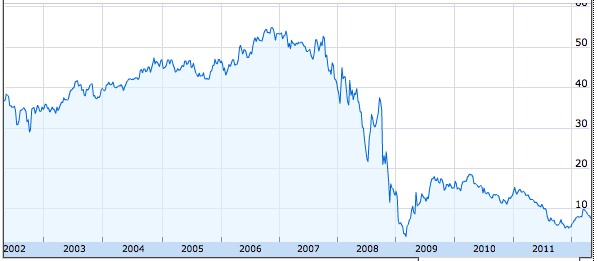
Yet the Dow thinks it’s 2007.

Here’s to keeping expenses low and profits high!

[Unemployment data (PDF) from Pew Charitable Trusts via Infectious Greed, Dow chart from Yahoo!]

Nov 042011
 

This is just a reminder that tomorrow, the 5th of November, is Bank Transfer Day.

The idea is to drop your commercial bank and transfer your funds to a not-for-profit credit union.

But what is a credit unionwhat’s the difference between a bank and a credit union, and why should you bother to change?

Who knows?

Ape Con Myth Devisions

© 2012 Ape Con Myth Suffusion theme by Sayontan Sinha